

Simplification, ad infinitum -- AI, academia, and the literacy crisis.
Read hard books.

AI can summarize your readings! It can write your texts to your friends! It can even fuck your wife!
Before I left for spring break, my friends and I published this issue of our campus magazine, of which I am the founder and editor-in-chief. It features not only a mockery of AI writing and hallucinations on our front page, but also an op-ed in which I scream into the void about literacy and the canonical events that lead to Ray Bradbury’s Fahrenheit 451. I’ll touch on those things later in more depth, but this, at last, is my attempt to consolidate my fragmented drafts and thoughts on artificial intelligence.
My past three years of experience with generative AI has been filtered through the lens of academia. I am surrounded by creatives and intellectuals who rage against the machine until the sweet siren song of convenience gets too loud, as well as peers with far less hesitance to outsource their education, who delude themselves into thinking they are learning by having three different bots tell them three different ways to approach a problem.
I’ll make fun of my friends to their face for their AI use, and they’ll give me the same treatment when I open that tab. As a whole, however, I pass no value judgement; because what we all recognize is that AI is a consequence of our education system. Its use, the bill for academia’s optimization fetish. We are brought up thinking grades are all that matters. Passing has always mattered more than learning. Besides, our brains adore shortcuts – if we can save ourselves hours of tough reading with a click, isn’t it tempting to do so?
True as that may be, this still leads us to the consequences of the consequence.
I recently watched this video about a professor admitting to his ample AI use in a piece in Nature. Now, I won’t rehash all of Angela Collier’s points—it’s worth watching the video if you want to hear her full thoughts on education, learning, and the generated illusion of both. What I will take and run with from this video, however, is the axiom “You can’t outsource learning.” If you search up “AI in Academia”, you’ll find ample content that all boils down to the same message, the same fears.
In the past however many years, “We pretend to work and you pretend to pay us” has become→ “We pretend to learn and you pretend to teach us.”
^ buy a uni student a coffee? ^
I was introduced to that insidious machine that is ChatGPT at the end of my junior year in high school—by none other than my English teacher, ironically enough. I don’t resent her for it, though I’m sure on some level, she must cringe at the memory.
According to the Pew Research Center, As of mid-2025, 34% of U.S. adults have used ChatGPT. Usage is highest among adults under 30 (58%) and for educational purposes. Roughly two-thirds of U.S. teens (64%) have used AI chatbots. Globally, 10% of adults have used it, with an estimated 700 million active users. Enough to worry me about our future, not enough to convince me we’re not in a bubble.
Writers everywhere have varied opinions of ChatGPT. My general consensus is that efficiency is a fine thing if you’re capable of being creative on your own ... At least, that’s what I wrote here when I first created this article, which has been brewing in my drafts for longer than I’ll admit.
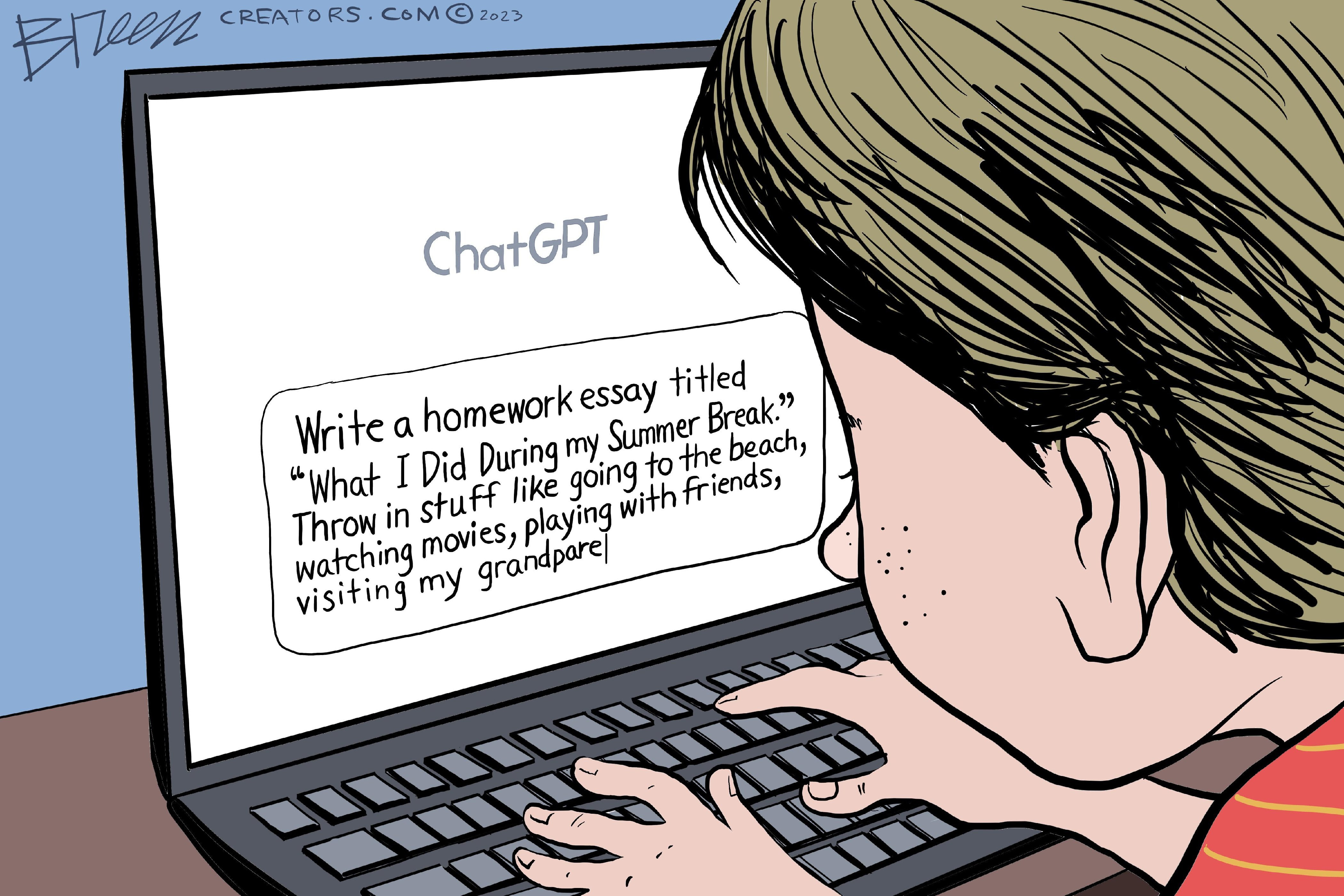
I have become more anti-AI day by day. I am so, so tired. And god, I am so fucking scared.
In contrast to my being a lifelong, voracious reader, my roommate is a bio-chem prodigy with an ample disdain for how English is approached in school, in large part due to his dyslexia. Now, my roommate is the funniest motherfucker on the planet, and one day, he had me doubled over in stitches after telling me: “I’ve read one book in my life, and it was Fahrenheit 451”.
For those familiar with Ray Bradbury’s novel, the irony is immediately apparent. Fahrenheit 451 is about a future American society where books are banned, a law enforced by “firemen” who burn them in order to suppress information and dissenting ideas.
In this narrative, we learn that reading died with a whimper, not a scream. By the time we read about the main character setting books on fire, they’d been long since voluntarily abandoned by the majority of the population. After all, they had such more entertaining things at their fingertips! Before they reached the point of burning books, however, they merely simplified their content.
“Books cut shorter. Condensations, Digests. Tabloids. Everything boils down to the gag, the snap ending.” —Fahrenheit 451, Ray Bradbury.
Fahrenheit further features the concept of "parlour walls," which serve as an eerie warning for modern, constant digital stimulation and screen addiction. The ability to sit through long-form content has been siphoned away, distilled into the short-form equivalent of sugary snacks and empty calories. Don’t think for a second that just because I’m writing this means I haven’t sent hours, days, weeks of my life down the drain — hell, I deleted TikTok again recently because I realized I just couldn’t focus on anything meaningful, couldn’t engage in things that bring me joy and fulfillment. I was, as Dostoevsky lamented, destroying myself for nothing.
Orwell, Bradbury, and Huxley were some of many canaries in the coal mines, and it seems too many people took their works as guidebooks for power, rather than as the cautionary tales they were meant to be.
“You don’ t have to burn books to destroy a culture. Just get people to stop reading them” —Ray Bradbury
I’ve been an aunt since I was two years old. Do that math yourself. As an aunt (and just as a human being) I’m existentially terrified for the younger generation, those who will be able to take any content they find difficult and command “simplify” ad infinitum.
That’s what has worried me since day one, and what has consistently shaken me when I think about what artificial intelligence is doing to us. Literacy rates have already been declining for years, and we’re going to watch it keep going into the fucking gutter.
I’m studying Economics and PPL1 — which is to say, I read a lot. And do I always like it? No, of course not. At worst, it’s tedious, time-consuming, confusing, difficult, and a hundred other adjectives of your choosing. But for practically all of human history, it has been our way of distributing and absorbing knowledge, wisdom, ideas …
AI summaries will save you time, but at the price of your reading comprehension, critical thinking, and patience. The brain is a muscle, and all around me, I am watching people gladly accept its atrophy. By god, aren’t we paying for the privileged of learning tough things? I suppose I can’t run that cost-benefit analysis for anyone, but that won’t keep me from screaming into the void about the insidious takeover of our lives by the psuedo-thinking machine, this trillion-dollar autocomplete that has eaten our economy and our livelihood in ways even Bradbury, in all his catastrophic forecasting, couldn’t have predicted.
Because truly, where have our attention spans gone? Hell, maybe that’s throwing stones in a glass house, or maybe that’s all this essay is. But at least I can confidentially say two things:
AI never touched anything written in this article.
I know I would rather skip a class reading entirely and have to figure it out mid-class discussion than have it chewed, digested, and spat up for me.
So if nothing else, keep reading. If you’ve made it to the end of this article, I take it you'‘re fine with that step. Ultimately, I don’t really care if I sound “preachy” when beg people to read books: difficult books, fun books,classic books, banned books. Newspapers, think pieces, and the instructions on the back of the airplane safety pamphlets. Just please, fucking read — And consider who benefits from you not doing so.
Philosophy, Politics and Law